


 WordPress Chatbot Plugins for Support and Automation
Find WordPress chatbot plugins for support, lead capture, product guidance, knowledge bases, WooCommerce, live-agent handoff and external AI service integrations.
 Scripts & Code7781
 App Templates2412
 Themes1109
 Plugins1
 CS-Cart2
 Drupal25
 Joomla43
 Magento2
 nopCommerce47
 Opencart0
 osCommerce30
 Osclass45
 Prestashop255
 WooCommerce607WordPress12
 Advertising36AI5Analytics5Backup12Booking20eCommerce27Forms19Gallery4GDPR54Interface Elements4Maps3Marketing4Membership7Newsletter4Notification14Performance33SEO14Sliders39Social Media31Security20Widgets223Miscellaneous1
 X-Cart51
 Miscellaneous14206
 Graphics
WordPress chatbot plugins can answer routine questions, collect leads, guide visitors to products or pass conversations to a human support team. This collection focuses on installable WordPress products rather than standalone PHP chat systems. Depending on the plugin, replies may come from predefined flows, a searchable knowledge base, an external AI provider or a live operator.
Choose a plugin based on the task it must perform and the information it is allowed to process. A simple contact assistant has different privacy, cost and accuracy requirements from an AI bot connected to customer orders. Browse the wider WordPress plugins collection for complementary site tools; standalone chat products remain in PHP chat scripts.






















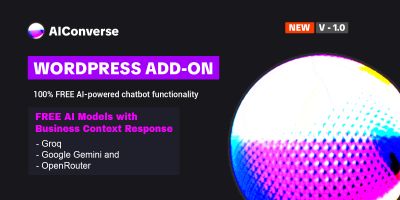




















Rule-based chatbots follow designed menus, triggers and response paths. They are predictable and useful for qualification, contact routing and frequently asked questions. Knowledge-based assistants search selected documentation or website content. Generative AI plugins can produce flexible replies, but require stronger controls for accuracy, cost and data exposure.
Identify the desired outcome before comparing feature lists. Lead-generation bots should store consent and pass structured information to a CRM or email service. Support bots need escalation, conversation history and office-hour behavior. Ecommerce assistants may require access to product catalogs or order data, which increases integration and privacy considerations.
- Visual conversation builder or configurable response rules
- Knowledge-base, page-content or document ingestion
- Lead forms, email capture and webhook integrations
- WooCommerce product discovery or order assistance
- Live-agent takeover and transcript management
- Language, styling, placement and mobile behavior
- Rate limits, usage reporting and administrator controls
External AI services normally require a separate account and API key. Review which provider and model versions are supported, how prompts are constructed and whether usage limits can be set. Costs may depend on message length and traffic. A plugin should fail gracefully when a provider is unavailable or a spending limit is reached.
Data handling must be transparent. Determine whether conversations are stored in WordPress, sent to third parties or used to train external systems. Avoid sending passwords, payment details, health information or other sensitive data through a chatbot unless the complete workflow has been assessed appropriately. Provide clear disclosure and a route to a person when automated answers are insufficient.
Performance and compatibility also matter. Test the plugin with caching, security software, multilingual plugins, page builders and the active theme. A chat widget should not delay the primary page content or create layout problems on small screens. Review update frequency because WordPress, WooCommerce and AI provider APIs change over time.
Select the simplest architecture that solves the business problem. Compare rule-based, knowledge-based and generative options, then confirm which integrations are included. Review the plugin changelog, compatibility statement, documentation and support policy.
Calculate recurring costs for AI usage, messaging services or live-agent platforms. Test data retention, export and deletion. Ensure that the widget remains usable with keyboard navigation and on mobile devices.
- Define the questions and actions the chatbot should handle.
- Check provider costs and configurable usage limits.
- Review privacy implications and transcript storage.
- Test theme, caching and WooCommerce compatibility.
- Create monitoring and escalation procedures before launch.
Do WordPress chatbot plugins require a separate AI account?
Generative AI plugins often require an account and API key from an external provider. Rule-based or locally managed plugins may not. Review provider availability, pricing and data terms.
Can a chatbot plugin answer questions about WooCommerce products?
Some plugins can search catalogs, recommend products or connect to order workflows. Confirm exactly which WooCommerce versions and data sources are supported.
Are chatbot conversations stored on the website?
Storage differs by plugin. Transcripts may remain in WordPress, pass through a vendor service or be sent to an AI provider. Check retention and deletion controls before collecting personal information.
Can visitors switch from the bot to a human agent?
Certain plugins include live-chat handoff, ticket creation or contact forms. Others are automation-only, so verify the escalation options needed by your support process.
Prepare a focused knowledge source rather than asking the bot to answer every possible question. Write clear fallback messages, escalation rules and contact options. Review transcripts to identify incorrect replies, missing information and common customer needs. Automation should reduce friction without concealing that a response is generated.
Protect API credentials and administrator settings. Assign only necessary user capabilities, keep WordPress and dependencies current, and test forms for spam or prompt-injection attempts. When the bot can retrieve order information, require appropriate authentication and avoid revealing another customer's data.
Use internal links from relevant product, support and WooCommerce pages where the chatbot can genuinely help visitors. Do not create thin pages for every phrase such as "AI chat plugin" and "support chatbot plugin"; those variants should support this single canonical collection.